
Dry-Land Exercises for Swimmers: Why Building Strength on Land Makes You Faster in the Pool
What you'll learn in this blog:
- What dry-land training actually is – and why it's not just "extra exercise"
- The four biggest benefits: power, injury prevention, core stability, and stroke efficiency
- Why a weak core ruins your body position in the water (and how to fix it)
- Age-appropriate dry-land exercises for kids vs adults (no heavy weights for young swimmers)
- A sample weekly dry-land plan you can do at home with minimal equipment
- How Swim Class Singapore helps swimmers build strength the right way
Every week, I see the same pattern at condo pools across Singapore.
A child swims three times a week. They're keen. They listen to their coach. But after a few months, their progress plateaus. Their kick is still sluggish. Their body position still sags. Their turns are slow.
The parent asks me: "Why isn't my child improving anymore?"
Here's the answer most swim schools won't tell you.
You can't build a fast swimmer in the water alone.
Think about it. Swimming is a full-body sport. Your arms pull. Your legs kick. Your core keeps everything connected. But in the water, you're weightless. You're not loading your muscles the way they need to be loaded to get stronger.
That's where dry-land training comes in.
Dry-land exercises – push‑ups, squats, planks, resistance band work – build the strength, power, and stability that make every lap faster, every turn sharper, and every stroke smoother. Research shows that combining dry‑land strength training with swimming has a positive effect on performance, regardless of age or gender, when properly designed. A 12‑week core training program alone has been shown to produce significant improvements in anaerobic power, core stability, upper‑body endurance, and overall swimming performance in elite adolescent swimmers.
At Swim Class Singapore, we don't just teach strokes. We help swimmers of all ages build the land‑based foundation that makes those strokes work. Here's what you need to know.
First, What Actually Is Dry-Land Training?
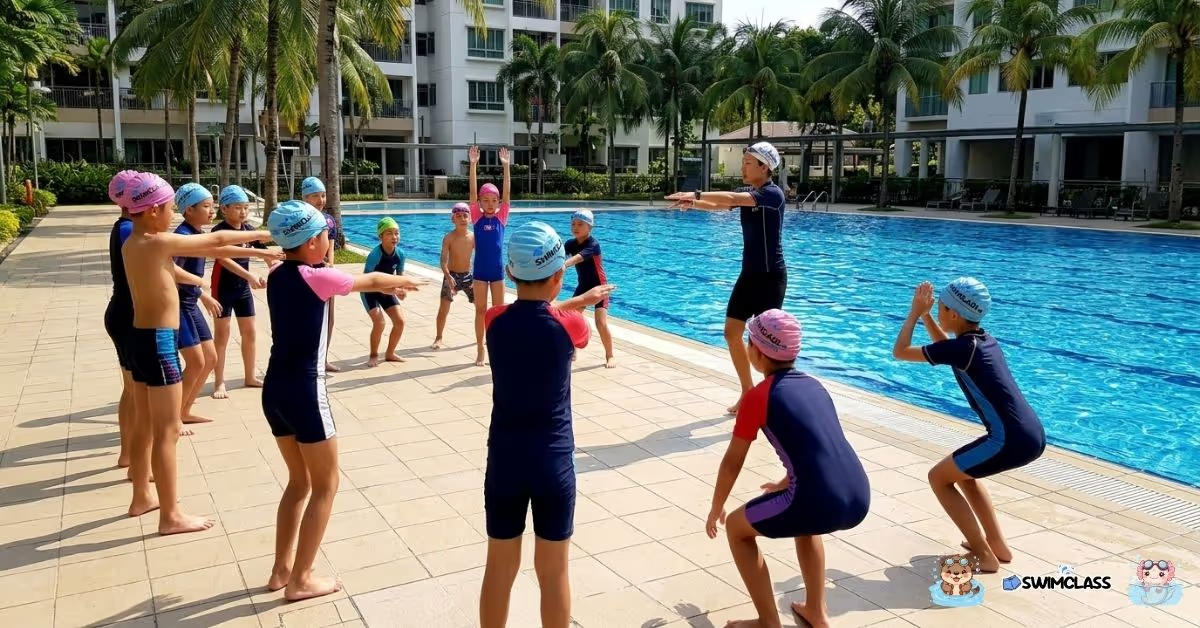
Dry-land training is exactly what it sounds like: structured exercises you do on land to improve your swimming.
It includes things like:
- Resistance band work (mimics the pull phase of freestyle) can be purchased from decathlon
- Bodyweight strength exercises (push‑ups, squats, lunges)
- Core stability drills (planks, leg raises, Superman holds)
- Plyometrics (jump squats, box jumps – for explosive starts and turns)
- Mobility and stretching (keeps shoulders and hips flexible)
The goal isn't to become a bodybuilder. It's to build swim‑specific strength – stronger shoulders, a solid core, powerful legs – all of which translate directly to faster, more efficient swimming.
Why Dry-Land Training Matters (The Four Big Benefits)
1. It Builds Real Power (Not Just Endurance)
Swimming is a sport that demands both endurance and explosive power.
Your child might be able to swim 100 metres without stopping, but can they explode off the wall? Can they get a powerful start? Can they maintain body position when they're tired?
Dry-land training develops the fast‑twitch muscle fibres that generate power. Plyometric exercises like squat jumps and box jumps have been proven to enhance swimming block starts and explosive turns. More power in the legs means stronger push‑offs. More power in the shoulders means faster arm recovery.
2. It Prevents Injuries (Especially Shoulder Injuries)
Swimming is repetitive. Thousands of strokes. Thousands of shoulder rotations. Over time, that repetition creates imbalances – weak rotator cuffs, tight chest muscles, loose shoulder joints.
Dry-land training corrects those imbalances.
Shoulder stabilisation exercises with resistance bands strengthen the small muscles around the shoulder joint. Core exercises protect your lower back. Stronger muscles distribute force more evenly, putting less strain on joints, tendons and ligaments. Targeting strength, posture and mobility helps stabilise joints and compensate for muscle deficits in some agonist/antagonist pairs.
In short: stronger swimmers get injured less.
If your child needs help with pool technique alongside land training, check swimming lesson availability in your area.
3. It Fixes Your Body Position (Through Core Strength)
Here's a secret that surprises most parents.
In the water, your child's hips sink when their core is weak. A sinking hip creates drag. Drag slows you down. Weak legs? More drag. Bad body position? Even more drag.
Dry-land training builds the core stability needed to maintain that long, flat, efficient body position. Planks, dead bugs, leg raises – these aren't just "extra exercises." They're the foundation of good swimming form.
4. It Reinforces Proper Technique (Muscle Memory)
When you're learning a new skill – like a proper catch or a smooth flip turn – your brain needs repetition. But pool time is limited.
Dry-land exercises allow you to practise those same movement patterns out of the water. Resistance band rows mimic the pull phase. Wall squats simulate the push off a turn. Flexibility work improves your shoulder reach.
The more you practise the movement correctly on land, the faster your brain learns it in the water.
One systematic review concluded that dry-land training for swimmers focuses on the development of abdominal muscular endurance, along with strength and power as the most important qualities. That's not guesswork – that's research.
Age‑Appropriate Dry‑Land Training (Kids vs Adults)
Not all dry-land exercises are suitable for all ages. Here's how we break it down at Swim Class Singapore.
Swimmers Aged 6–10
At this age, the goal is movement skills, not heavy weights.
Focus on:
- Running, crawling, climbing, skipping, jumping – basic gross motor skills
- Bodyweight exercises: push‑ups (on knees), squats, lunges
- Fun core work: superhero holds (like Superman), animal walks (bear crawls, crab walks)
- Balance drills: standing on one leg, hopping from spot to spot
- Flexibility through play
The goal is to teach children to enjoy physical activity and build a foundation of athleticism that will serve them when they're ready for more advanced training.
Swimmers Aged 11–14
This is the "sweet spot" for introducing structured dry-land training.
Focus on:
- More challenging bodyweight exercises: full push‑ups, pull‑ups (with assistance if needed)
- Elastic resistance band work for shoulders and back
- Core stability: planks, side planks, leg raises, flutter kick crunches
- Low‑impact plyometrics: box jumps (low box), squat jumps
- Good form is everything – quality over quantity.
Swimmers Aged 15+ (Including Adults)
At this level, you can introduce moderate resistance training.
Focus on:
- Pull‑ups, chin‑ups, dips
- Squats, deadlifts, lunges (with dumbbells or kettlebells if available)
- Medicine ball work for explosive power
- Heavy‑band resistance training for swim‑specific pulling strength
- Rotator cuff work with light bands (injury prevention)
A sample weekly plan might include:
- Day 1: Bodyweight strength + core
- Day 2: Cardio (running or cycling) + mobility stretches
- Day 3: Bodyweight strength + core
But remember: dry-land training complements – not replaces – pool time.
Sample Dry‑Land Workout (No Equipment Needed, 20 Minutes)
Here's a simple workout any swimmer can do at home. Perform 3 rounds, with 30 seconds rest between exercises.
Warm‑up (3 minutes)
- Light jogging or skipping – 1 minute
- Arm circles (forward and backward) – 1 minute
- Torso twists – 1 minute
Main set (15 minutes)
Perform each exercise in order. Rest 30 seconds between exercises. Complete 3 rounds total.
- Bodyweight squats – 15 reps
Builds leg power for turns and push‑offs - Push‑ups (on knees if needed) – 10 to 15 reps
Strengthens chest, shoulders, and triceps - Plank hold – 30 seconds
Core stability for better body position in the water - Lunges (alternating legs) – 10 reps per leg
Improves hip flexibility and leg strength - Superman holds – 10 reps, hold for 3 seconds each
Strengthens lower back and glutes – prevents sinking hips - Flutter kick crunches – 20 reps
Builds core endurance and leg lift strength
Cool‑down (2 minutes)
- Shoulder stretches – 30 seconds each side
- Quad stretch – 30 seconds each leg
- Deep breathing – 30 seconds
Aim to do this 2–3 times per week on non‑swim days.
The One Thing Every Swimmer Needs: A Strong Core
If you take only one thing from this article, let it be this:
The core is the engine of the swimmer.
A weak core means dropped hips. Dropped hips means drag. Drag means slower swimming.
A strong core means a long, flat, efficient body position. That means less energy wasted fighting the water. That means swimming faster with less effort.
Do the planks. Do the leg raises. Do the Superman holds. Your stroke will thank you.
Common Dry‑Land Mistakes (And How to Avoid Them)
Mistake #1: Doing too much, too soon
- Build gradually. Two 20‑minute sessions per week is plenty for beginners.
Mistake #2: Sacrificing form for reps
- Ten perfect push‑ups are better than twenty sloppy ones.
Mistake #3: Ignoring the cool‑down
- Stretching after exercise reduces soreness and improves flexibility over time.
Mistake #4: Using dry‑land as an excuse to skip swimming
- Dry‑land training supports your swimming – it doesn't replace it.
Mistake #5: Putting a 7‑year‑old on heavy weights
- Wait until they're physically mature. Bodyweight and resistance bands are safer and more effective for young swimmers.
How Swim Class Singapore Incorporates Dry‑Land Training
At Swim Class Singapore (swimclass.sg) , we don't just teach in the water. We take a holistic approach to your child's development.
We help families:
- Understand which dry‑land exercises are appropriate for their child's age and ability
- Build simple 15‑20 minute routines that fit into busy schedules
- Improve core strength, body position, and injury resilience
- Focus on quality of movement, not quantity of reps
Our affordable private lessons ($80) and group lessons (from $32.50) give your child consistent, high‑quality coaching. But we also believe that the best swimmers are built both in and out of the water.
If you're serious about your child's swimming progress, dry‑land training isn't optional. It's essential.
The Bottom Line
Your child can swim three times a week with the best coach in Singapore. But if they aren't building strength, stability, and power out of the water, they are leaving a huge part of their potential untapped.
Dry‑land training isn't about turning your child into a gym rat. It's about giving them the physical foundation – strong shoulders, solid core, powerful legs – that makes every minute in the pool more effective.
Start small. Two short sessions a week. Focus on form. Be consistent.
And watch the difference it makes in the water.
Frequently Asked Questions
What age can kids start dry-land training?
Basic movement-based dry-land work (running, crawling, bodyweight exercises) is appropriate from around age 6, focused on fun and coordination rather than structured strength training, which is better introduced around age 11-14.
How many days a week should swimmers do dry-land exercises?
2-3 sessions per week on non-swim days is a solid starting point for most swimmers, building gradually rather than doing too much too soon.
Do swimmers need weights for dry-land training?
No, not for younger swimmers. Bodyweight exercises and resistance bands are safer and effective for kids and early teens; moderate weights can be introduced from around age 15 onward.
Can dry-land training prevent swimming injuries?
Yes, particularly shoulder injuries. Strengthening the muscles around the shoulder joint and building core stability helps correct the imbalances that repetitive swimming strokes can create.
What's the single most important dry-land exercise for swimmers?
Core stability work — planks, leg raises, and similar exercises — since a weak core causes the hips to sink in the water, creating drag that slows swimmers down regardless of stroke technique.
Ready to Build a Stronger, Faster Swimmer – In and Out of the Water?
Book an affordable swimming lesson at Swim Class Singapore – we'll help your child build the skills and strength they need to swim faster, safer, and with better technique.
👉 Book a lesson at swimclass.sg
Want to learn butterfly stroke? read our butterfly stroke guide
Ready to find a suitable coach? Check swimming lesson availability for your preferred area and schedule.
Why Parents Love Swimming Lessons at Swim Class Singapore
Parents across Singapore trust Swim Class because we focus on both safety and fun.


Our lessons emphasize child-friendly teaching methods, small group attention, clear progression and skill development, and positive, encouraging instructors who help every child build confidence in the water.
Most importantly, we help kids build confidence in the water while enjoying every lesson.
Frequently Asked Questions About Kids Swimming Lessons
Everything parents usually ask before their little swimmer jumps in — from safety and schedules to choosing the right class.
Absolutely. Our baby swimming classes in Singapore are designed with safety as the top priority. Lessons are parent-assisted and led by certified swim instructors who specialize in helping babies and toddlers feel comfortable, confident, and happy in the water. Every session is gentle, structured, and designed to make those first splashes a positive experience.
It’s easier than you might think. Our kids swimming lessons in Singapore are organized by age and skill level, from baby swimming to beginner and intermediate programs. Simply share your child’s age and swimming experience, and we’ll recommend the class that helps them learn, progress, and enjoy the water at their own pace.
Yes, we offer swimming lessons at both condo pools and public swimming complexes across Singapore. This gives families the flexibility to choose the location that is most convenient for them.Lessons at public swimming pools are open to all students who want to join our swim classes.Lessons conducted at condo pools are available for residents of that condominium only, in accordance with condo management rules. If you live in a condo with a pool, we can arrange lessons right at your residence for added convenience.Just let us know your preferred location, and we’ll help match you with the best swimming lesson option in Singapore for your little swimmer.
Both options are available. We run swimming lessons at condo pools and public swimming complexes across Singapore, so you can choose the location that’s most convenient for your family. Once you tell us your preferred area, we’ll match you with a coach nearby.
Children can begin baby swimming lessons from around 6 months old. Starting early helps babies develop water confidence, basic safety awareness, and comfort in the pool — all while having fun and bonding with their parents.
Yes, we do. Our instructors provide SwimSafer preparation lessons in Singapore, helping children develop the swimming skills and water safety knowledge needed for the national SwimSafer programme. Lessons focus on both technique and confidence so kids feel ready for the next stage.
Still Curious? Let’s Chat!
Got a question about baby swimming, kids swimming lessons, or SwimSafer prep in Singapore? Our friendly team is happy to help you find the perfect class for your little swimmer.
Book your child's first lesson
Start your child’s swimming journey in Singapore with certified coaches who specialize in baby and kids swimming lessons. We’ll help your little swimmer build confidence, safety skills, and strong swimming technique from the very first splash.